CASE OF THE KICHWA PEOPLE OF
SARAYAKU VS. ECUADOR
San José, Costa Rica, June 19, 2026

View the official document from this link
Following the private hearing to monitor compliance by the Inter-American Court of Human Rights, the representatives of the Kichwa People of Sarayaku and their legal defense demonstrated that the Ecuadorian State continues to fail to comply with fundamental measures ordered by this court since 2012.
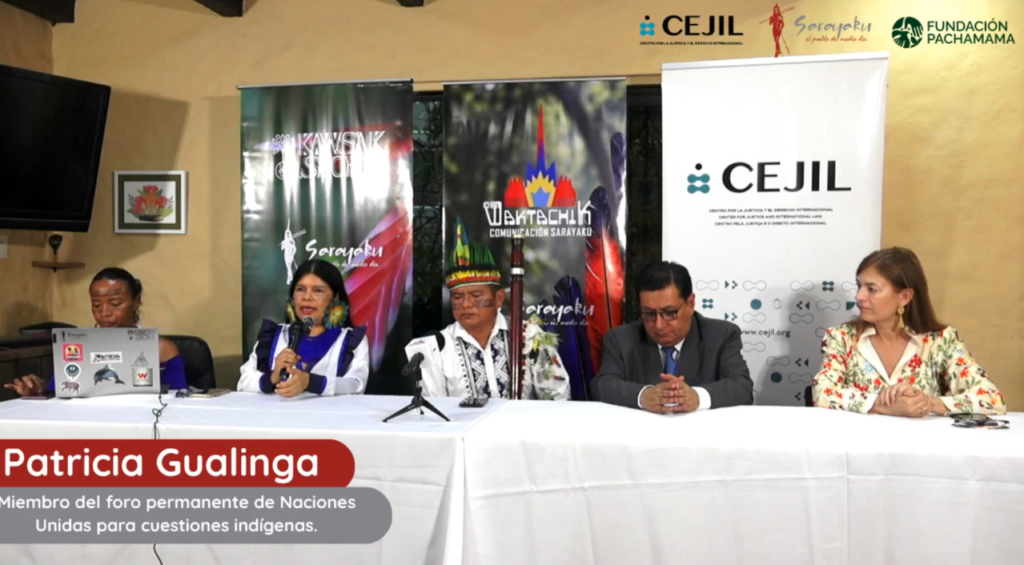
The Sarayaku case originated when an oil company operated in the ancestral territory without prior consultation, which led to the case being brought before the Inter-American Court of Human Rights and a final judgment issued 14 years ago, in which violations of the collective rights of the people were recognized.
Kichwa people of Sarayaku. Since then, the Court has ordered concrete measures—including the drafting of a consultation law, the effective guarantee of consultative processes and the removal of explosives—which have not yet been fully implemented by the Ecuadorian State.
In this space, considered fundamental after 14 years of the ruling in favor of the people, the non-compliance with the sentence was demonstrated and the State's blatant disregard for three essential measures was highlighted:
● Obligation to legislate: the failure to create a law on prior, free and informed consultation and consent that meets constitutional and international human rights standards.
● Guarantee of consultation: the State's disregard for the obligation to consult on any type of management or project that could directly or indirectly affect the rights or territory of Sarayaku.
● Removal of explosives: the disregard for the obligation to remove the ton and a half of pentolite, a high-caliber explosive left abandoned by the oil company in 25,000 hectares of the territory, which continues to be a serious and imminent threat to the life and integrity of the People and their Living Forest.
Given the Ecuadorian State's persistent non-compliance, the Sarayaku people propose that, as a way to redress and remedy something that cannot be healed, the territory of Sarayaku Kawsak Sacha (Living Forest) be declared a conscious entity and a subject of rights. They reaffirm that achieving this recognition through a legal framework would set a far more significant precedent regarding respect for the rights of nature and the rights of Indigenous peoples.
Yesterday's hearing confirms that the case remains open and that compliance with the sentence continues to be a debt of the Ecuadorian State.
For more information on the context and impact of the case, Visit the CEJIL website