Read the Judgment of the SARAYAKU CASE by the Inter-American Court of Human Rights Sarayaku Case Judgment
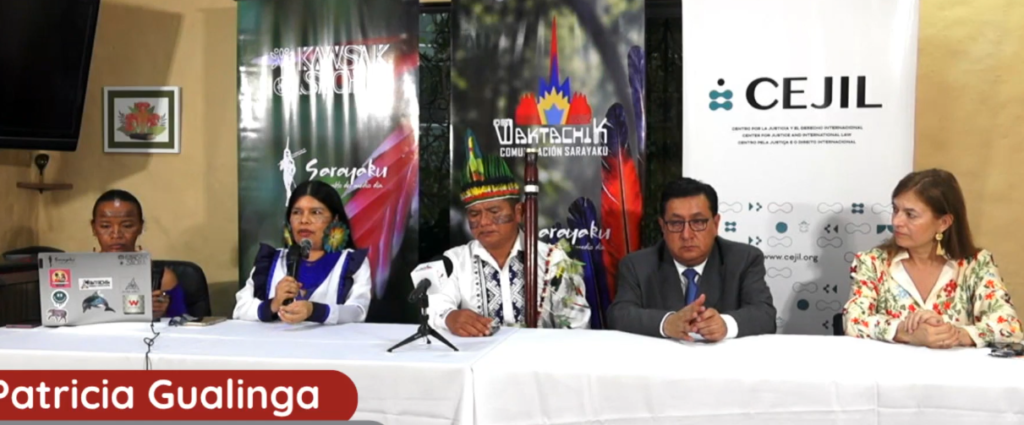
In 2003 Sarayaku went to the Inter-American Human Rights System to ask for justice. That same year the Inter-American Commission granted Precautionary Measures to Sarayaku. In 2004 and 2005, the Inter-American Court issued Provisional Measures in favor of the people, including the provision that the State remove the explosives planted by the CGC in the territory of Sarayaku. At the beginning of 2010, the Inter-American Commission issued its resolution regarding the Sarayaku Case.
Thanks to the struggle of Sarayaku and its allies before International Justice, the CGC company has been able to leave the territory and the Ecuadorian State begins to remove the explosives from the territory. However, the fight will continue to ensure that the threat of oil on Sarayaku and their rights is never repeated.
Read the Judgment of the SARAYAKU CASE by the Inter-American Court of Human Rights Sarayaku Case Judgment
Sarayacu has a long history of opposition to oil exploitation, due to its serious environmental and social impacts. In 1989 we prevented the ARCO company from finishing its oil explorations within our territory. The conflict with CGC began in 1996 when the government of Ecuador and the General Fuel Company (CGC) of Argentina signed an oil exploration contract in "block 23", covering 200,000 hectares of which most is territory. of Sarayacu. The people of Sarayacu were not consulted and from the beginning we opposed oil exploration.
Because Sarayacu is the community that has the most inhabitants and the most territory within block 23, CGC first approached Sarayacu, trying to deceive people through offers of money and development works. He managed to bribe Telmo Gualinga, president of Sarayacu from 1997 to 1999, giving him a personal contract to build a drinking water system in his neighborhood of the community. The company was so sure that it would convince us that it publicly stated that it would not start any exploration work before obtaining 100% support from the communities on the block. However, the people of Sarayacu did not accept the oil activity, and subsequent presidents did not allow themselves to be bribed. Therefore, from 2000 until now, the CGC has maintained a true war of slander against Sarayacu, with the aim of destroying trust between the people and their own leaders. Since it was unable to destroy Sarayacu, the CGC began to make contact with other smaller communities, hiring their leaders directly, and thus managed to enter several other communities.
The CGC's strategy is based on bribery, disinformation, and social disintegration, and violates articles 84 and 88 of the Political Constitution of the Republic of Ecuador. The American oil company Burlington Resources also appears as a shareholder in block 23.
In 2003, the Association of the Kichwa People of Sarayaku (Tayjasaruta), with the support of various national and international organizations, filed a complaint with the Inter-American Commission on Human Rights (IACHR). The IACHR is one of the two organs of the Organization of American States (OAS) in charge of the promotion and protection of human rights in the American continent, and acts as the first international instance before accessing the Inter-American Court of Human Rights (IA Court).
The complaint alleged violations by Ecuador of the People's rights to property, protection and judicial guarantees, freedom of movement, integrity, life, political participation, freedom of conscience and religion, health and culture.
While resolving the case, the IACHR decided in 2003 to request that the Ecuadorian State adopt protection measures to safeguard the life and integrity of the members of the Kichwa people of Sarayaku. Likewise, it ordered the State to investigate the acts of violence and take the necessary measures to protect the particular relationship that the People maintains with its territory. Given that the State did not comply with the measures, the IACHR asked the Inter-American Court to order the State to adopt provisional protection measures. In 2004, the Court ordered the State to adopt the necessary measures to protect the life and integrity of the members of the town, to guarantee their free movement and to identify those responsible for the acts of violence against the members. of Sarayaku.
In December 2009, the IACHR issued a substantive report concluding that Ecuador had violated, among others, the Sarayaku's rights to life, integrity, property, and judicial guarantees. The IACHR issued a series of recommendations to the Ecuadorian State, which were not complied with.
Based on this, the IACHR decided to file a lawsuit before the Inter-American Court in April 2010. The Court is the jurisdictional body for the protection of human rights of the OAS, in charge of enforcing the American Convention on Human Rights by all States. OAS members that ratified it and recognized the jurisdiction of the Court, including Ecuador. The Court, in this way, is the parallel court in the American continent to the European Court of Human Rights.
Current status of the jurisprudence of the Inter-American Court regarding the rights of indigenous peoples. Few cases related to the rights of indigenous or tribal peoples have come before the Inter-American Court: only fifteen sentences compared to the nearly 130 contentious cases that the Court has heard since 1987 (These cases have provided the Court with the opportunity to interpret the American Convention on Human Rights in light of the cultural specificities of traditional societies.
Of these fifteen rulings issued by the Court regarding violations of the rights of indigenous or tribal peoples, only six have referred to the territorial rights of these peoples. Based on the “right to private property” set forth in the Convention, the Court has developed the right of members of traditional peoples to their ancestral territories. Thus, it has affirmed their right to be recognized as owners of their ancestral lands and of the traditionally used natural resources found therein. This jurisprudence resulted, on the one hand, in the affirmation of the right to restitution of territories of the peoples that were illegally dispossessed, and, on the other hand, in additional conditions to be able to carry out an expropriation. In this way, if the States want to exploit natural resources in indigenous territories, they are obliged to carry out prior environmental and social impact studies, to consult the interested people in order to obtain their consent, and to share the benefits. In addition, when it comes to large-scale projects, which may have a greater impact on the territory, the States are obliged to obtain the consent of the indigenous community.
The case of the Kichwa People of Sarayaku and its potential to allow a consolidation of jurisprudence. The examination of this case by the Inter-American Court is of great importance, since it could allow the Inter-American system for the protection of human rights to specify and strengthen its jurisprudence on the rights of indigenous and tribal peoples to their ancestral territories.
Importance of the present case given the situation of exploitation of resources in ancestral territories. Unfortunately, the case of the Sarayaku People for preserving their territory and ensuring their survival is not the only one in the Americas. On the contrary, it exemplifies the struggle of the ancestral peoples in the Americas against the omnipresence of companies that exploit natural resources or that carry out megaprojects, such as the construction of dams or highways, seriously affecting said territories.
We must not forget that the States, the only ones that can be sanctioned by the Inter-American Court, are internationally responsible before it if they do not comply with their obligations regarding activities carried out in indigenous territories by private companies. In this sense, the ruling of the Court in the Sarayaku case could have an impact, not only in terms of the obligations of Ecuador, but also of the other States parties to the American Convention, to respect the rights of indigenous and tribal peoples. .
Reaffirmation of the obligation to obtain free, prior and informed consent
Precisely, one of the conditions that the Court should impose in this case, beyond simply consulting the community, is obtaining their free, prior and informed consent, since it is an extractive project that has a significant in the welfare and rights of the Sarayaku People. Therefore, the case could serve the Inter-American Court to delve into the scope of this right.
The obligation to consult is being criticized by the States because, according to them, it constitutes a brake on their “development”. However, it is essential considering that the territories are the basis for the survival of indigenous and tribal peoples. A study by the UN Rapporteur on the rights of indigenous peoples regarding the consequences of large-scale development projects on the rights of indigenous communities, observes that as a consequence of these activities, indigenous peoples are victims of "profound social and economic changes that the competent authorities are often unable to understand, let alone foresee. Large-scale development projects will inevitably affect the living conditions of indigenous peoples. Sometimes the effects will be beneficial, very often devastating." The Rapporteur, in his report referring to his visit to Ecuador in 2006, recommended that the concessions granted to oil companies be reviewed.

Amid a critical situation due to flooding and numerous COVID-19 infections, Sarayaku will be [...]
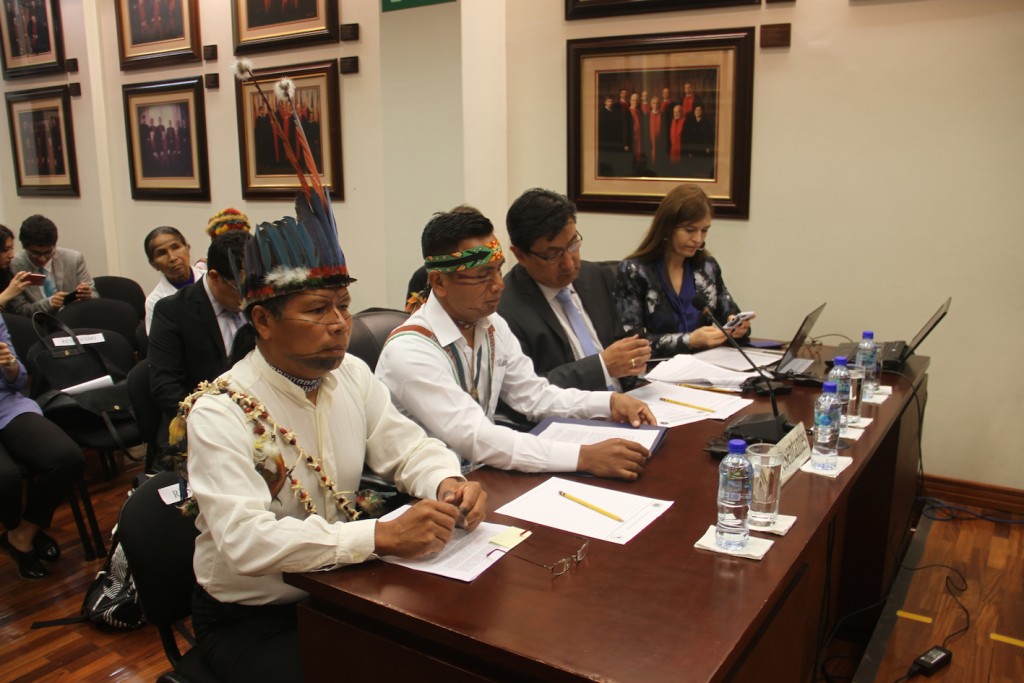
San José, December 1, 2016 - Leaders of the Kichwa Indigenous People of Sarayaku; their [...]

INVITATION TO THE LIVE STREAM OF THE COMPLIANCE MONITORING HEARING [...]
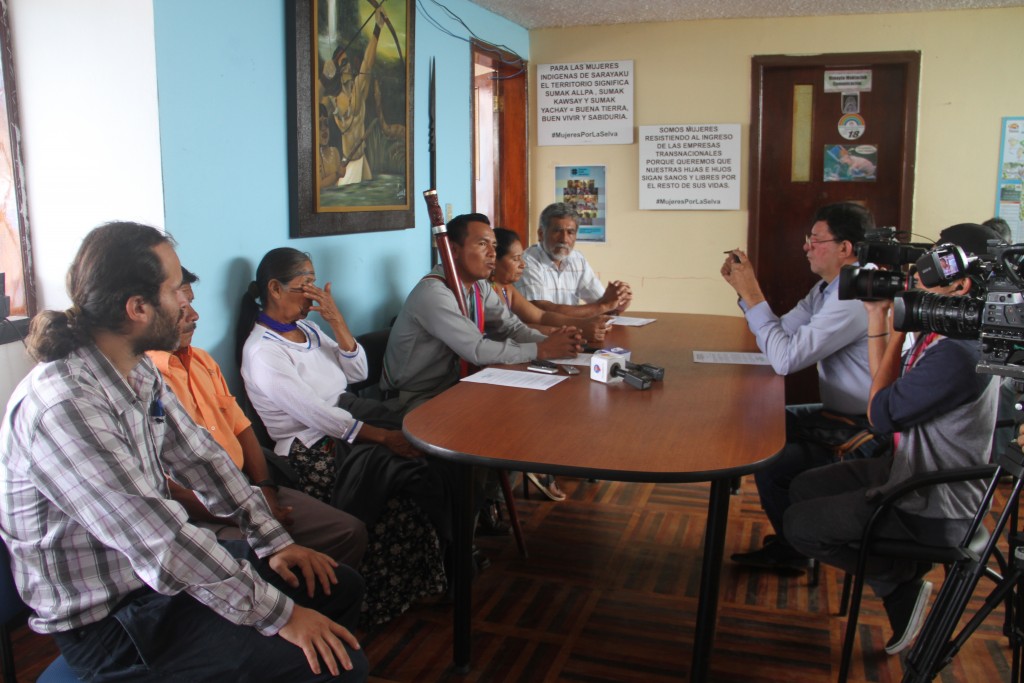
PRESS RELEASE Sarayaku, November 28, 2016 Compliance Monitoring Hearing [...]

Four years have passed since the Inter-American Court of Human Rights declared that the Ecuadorian State [...]

Four years after the ruling of June 27, 2012 [...]

Case of Kichwa indigenous people of Sarayaku vs. Ecuador Act of [...]

The Kichwa people of Sarayaku express concern on the second anniversary of the sentence issued [...]

On March 11, 2014, in the province of Pastaza, Ecuador, in [...]

Overflight in Sarayaku territory. [...]

SARAYAKU, the people of the Milieu du Jour Sarayaku, on December 5, 2013 AUX CITOYENS DU [...]

If the so-called citizens' revolution wants to sell our territories, our homeland, then let it be [...]

Press Release Photo by Sarayaku Communications Team Amazonian women request hearing [...]

Mr. José Gualinga, Tayak Apu of the Kichwa Native People of Sarayaku, continues his tour [...]

Sarayaku reaffirms its demand for the President of the Republic to offer a public apology. Bulletin of [...]

Sarayaku press release regarding statements from the Ministry of Justice on compliance with [...]

Speech by José Tayak Apu during the first anniversary celebration in Sarayaku. Today [...]

At the time of the “tiam” Sarayaku celebrates the first anniversary of the Inter-American Court of Human Rights ruling [...]

On the first anniversary, Sarayaku plans to hold celebrations of the ruling, beginning [...]

IACHR JUDGMENT: FIRST ANNIVERSARY TO BE CELEBRATED IN QUITO AND SARAYAKU Puyo, July 19 [...]

[...]

The Kichwa people of Sarayaku held a third technical working meeting with the commission [...]

Party in the Sarayacu Jungle, Sunday, February 24, 2013, by El Universo [...]

INVITATION The Kichwa Indigenous People of Sarayaku will celebrate the “UYANTZA”, their great bi-festival [...]

Sarayaku case: the removal of explosives will be decided on February 20. Friday, 11 [...]

Pakayaku, December 15, 2012. DECLARATION OF THE POLITICAL COUNCIL OF THE PEOPLES [...]

Sarayaku, an example of resistance. Saturday, December 8th, General Assembly, Day 1. In [...]

http://http://www.dw.de/no-slo-yasun-sino-la-amazona-entera/a-16421392Contexte : Les ressources pétrolières sont-elles à même d'assurer un développement durable en Equateur? To what price? [...]
Thursday, November 29, post-spill note This could be the headline of a [...]
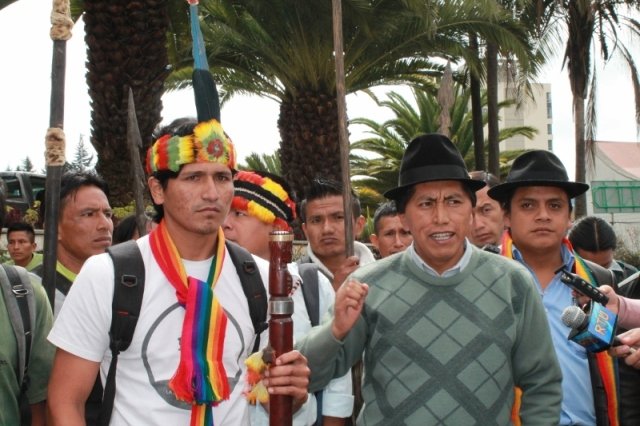
Rejection of the 11th Oil Round in Quito: “Life is being negotiated.” This is how [...]

Colloquium «In the Footsteps of Danielle Mitterrand» Friday, November 23, 2012 In [...]

Sarayaku, October 24, 2012. Photo: Sarayaku Communication. Dr. Alexis Mera Soler, National Secretary [...]

Sarayaku filmmaker Eriberto Gualinga accepted the award on behalf of his community. [...]

Open letter addressed by the Kichwa People of Sarayaku to the President of Ecuador Sarayaku, 13 [...]
Sarayaku celebrates historic ruling. The Kichwa Native People of Sarayaku will celebrate next Sunday, 12th [...]
Kito, July 30, 2012: - Through a press conference at the premises of the [...]
The Kichwa Indigenous People of Sarayaku cordially invite you to the press conference following the ruling [...]
Download the letter here German English French Today, Wednesday, July 25th [...]
Download Now: Summary Sarayaku Sentence Sarayaku Sentence June 27, 2012 Note Read more!
Read here the PRONOUNCEMENT
Interview with President José Gualinga on Ecuavisa, Saturday, April 21, 2012. At this moment [...]
This Saturday, April 21, a delegation from the Inter-American Court of Human Rights (Court [...]
Sarayaku, April 18, 2012. The Governing Council of Tayjasaruta and the People [...]
Watch this video in English. Download the invitation here. After eight years of a [...]
STATEMENT ON THE INTER-AMERICAN COURT'S VISIT TO SARAYAKU Download the invitation here. Would [...]
STATEMENT ON THE VISIT OF THE INTER-AMERICAN COURT TO SARAYAKU The Kichwa Indigenous People of [...]
This Monday, July 11th at 10:30 AM at CONAIE, representatives of the Indigenous People of [...]
By: Ecuador Inmediato. For AUDIO, click here. Quito, July 9, 2011. The State [...]
Quito, July 7, 2011. Institutions, organizations, students, and the media were attentive [...]
San José, July 6, 2011. “I am the son of a people who have been [...]
By: El Universo, Thursday, July 7, 2011. At the Faculty headquarters [...]
By: El Tiempo http://www.eltiempo.com.ec/noticias-cuenca/72245-culmina-primera-jornada-de-la-audiencia-en-el-caso-sarayacu/ Publication Date: 2011-07-07 11:15 At the time, Don Sabino Gualinga, [...]
San José, Costa Rica, July 5, 2011. The Kichwa Sarayaku People, of the [...]
Full letter icon Shiwakucha Community June 24, 2011 Gentlemen. MEMBERS OF THE [...]
On July 6 and 7, 2011, in San José, Costa Rica, [...]
The Minister of Mines and Petroleum, Galo Chiriboga, during a visit to Sarayaku, promised that [...]
On Monday, October 16, 2006, the UN Special Rapporteur on [...]
On Monday, March 13, 2006, in Washington, D.C., [...]